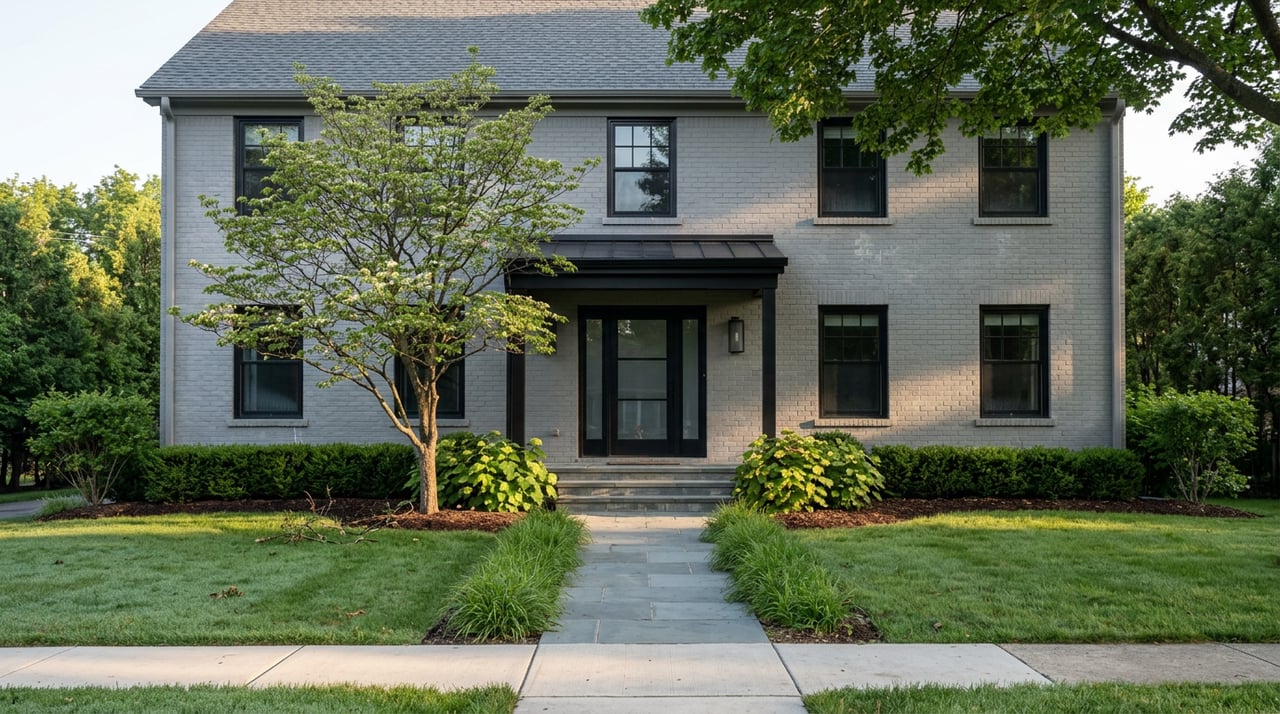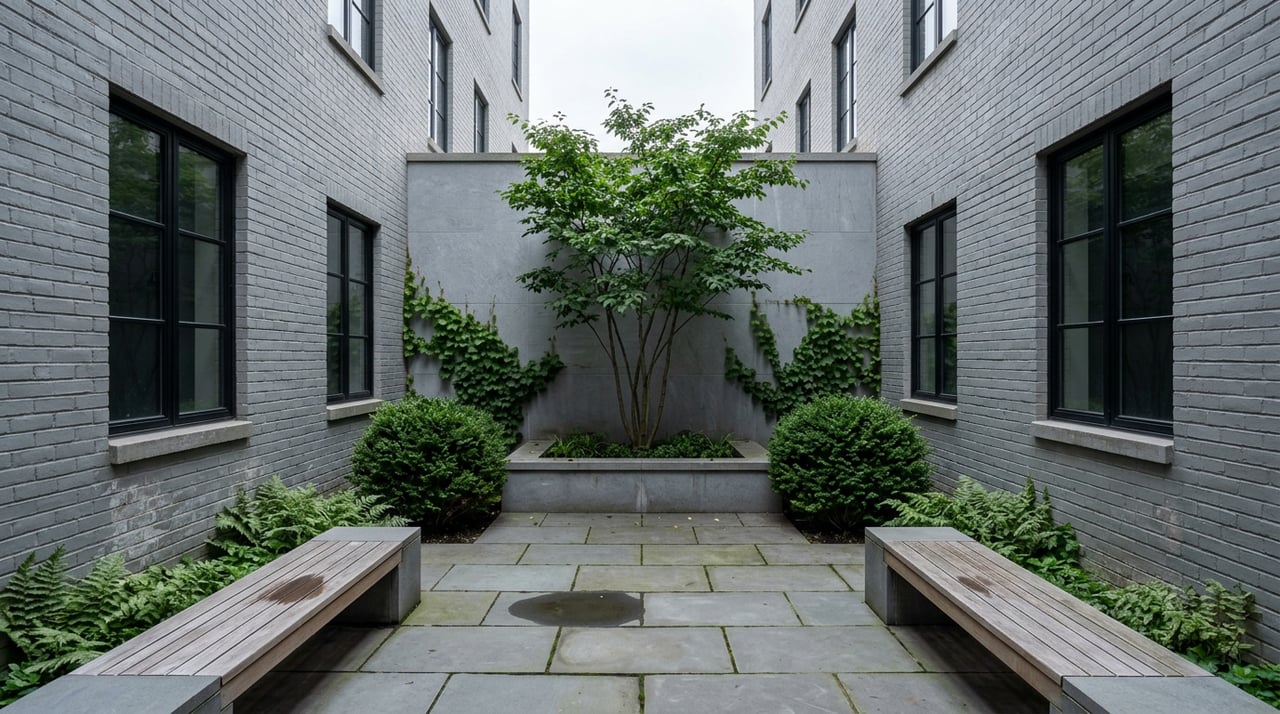
Walk east from Third Avenue on your lunch break this week and you will pass three small green spaces that feel like they belong to the neighborhood the way the sidewalk does. They do not. Greenacre Park, Paley Park, and Tudor City Greens are three of the most-used outdoor rooms in Midtown East, and not one of them was built, paid for, or is currently maintained by the City of New York. A CBS chairman bought them. A Rockefeller granddaughter donated them. A group of co-op residents fought a developer for them. The parks that make this stretch of Manhattan livable were private decisions before they were public amenities, and that origin still shapes how they operate today.
This matters for anyone who already lives here, because it explains something that can otherwise feel like luck: why a fifteen-minute walk from Grand Central still produces pockets of real quiet, and why those pockets have survived seventy years of rezonings, tower approvals, and neighborhood turnover that flattened plenty of other small spaces around the city.
A Chairman, a Dead Nightclub, and a Waterfall
Paley Park, at 3 East 53rd Street between Fifth and Madison, sits on the former site of the Stork Club, the nightclub that once defined Midtown nightlife. William S. Paley, the longtime chairman of CBS, bought the site, tore the club down, and financed a park through the William S. Paley Foundation as a memorial to his father, Samuel Paley. It opened in 1967, designed by architect Robert Zion, and it became the prototype for what planners started calling the "vest pocket park," a concept Zion had first proposed at a 1963 exhibition at the Architectural League of New York.
The design choices were specific and deliberate. A 20-foot wall of water at the back of the lot runs at 1,800 gallons a minute, loud enough to cancel out Midtown traffic without anyone needing to raise their voice over it. Seventeen honey locust trees are planted on a grid to create dappled shade over movable wire chairs and marble tables, an arrangement urban sociologist William H. Whyte later studied in his 1980 film and book, The Social Life of Small Urban Spaces, to understand why people gravitate toward this particular corner of pavement over so many others nearby.
Four blocks away, Greenacre Park at 217 East 51st Street between Second and Third follows the same private logic with a different benefactor. It opened in 1971 as a gift from Abby Rockefeller Mauzé, daughter of John D. Rockefeller Jr., assembled from three lots that had previously held a store, a garage, and part of a synagogue. Architect Hideo Sasaki, who chaired the design faculty at Harvard, designed it in consultation with Harmon Goldstone. Its signature feature is a 25-foot waterfall built from sculpted granite blocks, arranged across three distinct levels that each feel like a separate room. The park draws an average of 700 visitors a day and earned a spot on the National Register of Historic Places in 2018.
Here is what those two parks and Tudor City Greens have in common, and where they differ:
| Park | Opened | Funded and owned by | Signature feature |
|---|---|---|---|
| Paley Park | 1967 | William S. Paley Foundation | 20-foot waterfall, honey locust canopy |
| Greenacre Park | 1971 | Greenacre Foundation | 25-foot granite waterfall, three levels |
| Tudor City Greens | 1920s, public access since 1997 | Tudor City Greens Inc. | Japanese maples and magnolias above 42nd Street |
Tudor City Greens has the oldest roots and the most unusual path to public status. The two gardens were built as part of the original Tudor City development in the 1920s, when the Fred French Company converted a squatters' settlement between First and Second Avenues into the city's first residential skyscraper complex. They stayed private amenities for Tudor City residents for most of the twentieth century. Only in 1997, after residents organized to fight off developers who wanted the land, did the gardens become legally open to the public. The complex earned Historic District designation from the city in 1988 and a spot on the National Register of Historic Places soon after. A nonprofit, Tudor City Greens Inc., still runs the day-to-day upkeep.
The Year the Foundation Almost Lost the Light
Private ownership has kept these parks intact, but it has also left them exposed in ways a city-run park rarely is. In 2017, the Greenacre Foundation found itself fighting a rezoning plan that would have allowed taller towers on parcels near the park. The foundation commissioned its own shadow study and concluded that several of the proposed sites could put Greenacre Park in near-total darkness for much of the day. The city's own shadow study reached a different conclusion, finding the rezoning would not meaningfully affect the park.
The foundation's "Fight for Light" campaign drew support from the Municipal Art Society, then-Manhattan Borough President Gale Brewer, and City Councilman Daniel Garodnick, whose district included the park. The City Council approved the rezoning anyway in August 2017. Greenacre Park is still there today, still drawing its daily crowd, but the episode is a reminder that a privately owned park has no automatic protection against what gets built around it. Its survival depends on a foundation with the resources and the standing to make its case, not on a zoning designation that guarantees the light stays on.
Paley Park carries its own quieter version of that dependence. A small plaque near the entrance reads:
This park is set aside in memory of Samuel Paley, 1875-1963, for the enjoyment of the public.
It is a gift, phrased as a gift, and it operates on the same terms today that it did in 1967. Nobody has to renew a franchise for it to keep running. Nobody has to appropriate a line item for it either. Both are true at once, which is exactly the tradeoff.
What Took the City Seventeen Years
Contrast all of that with the one major piece of Midtown East open space the city actually built. The East Midtown Greenway and Andrew Haswell Green Park, spanning East 53rd to East 60th Streets along the river, opened in December 2023 after a $197.6 million investment from the city, delivering nearly three acres of new pedestrian walkway, a separated bike lane, and a pedestrian bridge at 54th Street. State Senator Liz Krueger noted at the ribbon cutting that she had first written to City Hall asking for this exact stretch of waterfront back in February 2006. Seventeen years passed between that letter and a finished path.
The segment linking that greenway back down to 41st Street, past the United Nations, is still in design as of this year. It is a useful data point for anyone who assumes public infrastructure moves faster than private philanthropy. In this neighborhood, the opposite has generally been true. A single donor built Paley Park in roughly four years, start to open. The public esplanade along the same river took nearly two decades of advocacy to deliver nine blocks.
The Circuit, and the Rules Nobody Posts
None of this is abstract if you actually want to use these spaces on a Tuesday afternoon. A few practical notes worth knowing before you go:
- Greenacre Park runs its waterfall from April through December and has heat lamps in its covered upper terrace for cooler days, so a January visit will look different from a June one.
- Tudor City Greens is open daily from 6 a.m. to 9 p.m., and posted rules ask visitors to leave dogs at home and skip feeding the pigeons, a stricter code than you will find in most city-run parks nearby.
- Carol's Café inside Greenacre Park handles sandwiches, coffee, and breakfast if you want to turn a bench visit into a real break.
- The Turtle Bay Association, the neighborhood group that has pushed back on land use fights here since 1957, held a members' happy hour this June at Ánimo's newly renovated space on Second Avenue, and has its second annual Taste of Turtle Bay scheduled for Saturday, October 3, 2026, a good marker if you want a sense of what the association is currently working on beyond parks.
The pattern across all of it is the same. What makes Midtown East feel calmer than its office towers suggest was mostly built by people who did not have to build anything at all. That is worth knowing if you already live here, because it means the character of the neighborhood is tied to a handful of private foundations and resident associations doing ongoing, largely invisible work, not to a city parks budget that will always fund it by default.
If you are weighing a move within Midtown East, or wondering how a building's proximity to Greenacre Park or the greenway actually affects daily life versus a listing sheet, the Steven Kramer Team knows this stretch of Manhattan block by block. Request a confidential consultation when you are ready to talk specifics.